EUROVISION 2026 - OFFICIAL TECHNICAL SUPPLIER
A New Frontier for Live Performance
The Eurovision Song Contest is the biggest live music event in the world. Around 160 million people watch on television and roughly 13,000 fill the arena, and the production is built to be fault free: fully redundant, rehearsed to the second, and careful with every choice it makes. Which is why it was such an honour that ART::IP, our newest system and only just released, was chosen to be part of the show. Music mix engineer Johannes Minichmayr and show mix engineer Richard Redl were looking for a way to solve a problem the contest had never fully cracked, and they were sure Amadeus Acoustics had the answer. They brought ART::IP in themselves, and it became the first time the system was ever used at Eurovision. On a stage this demanding, that choice was a testament to the quality and reliability of our technology, and Amadeus Acoustics was appointed an Official Technical Supplier for the event.
The Challenge: Two Stages, One Room
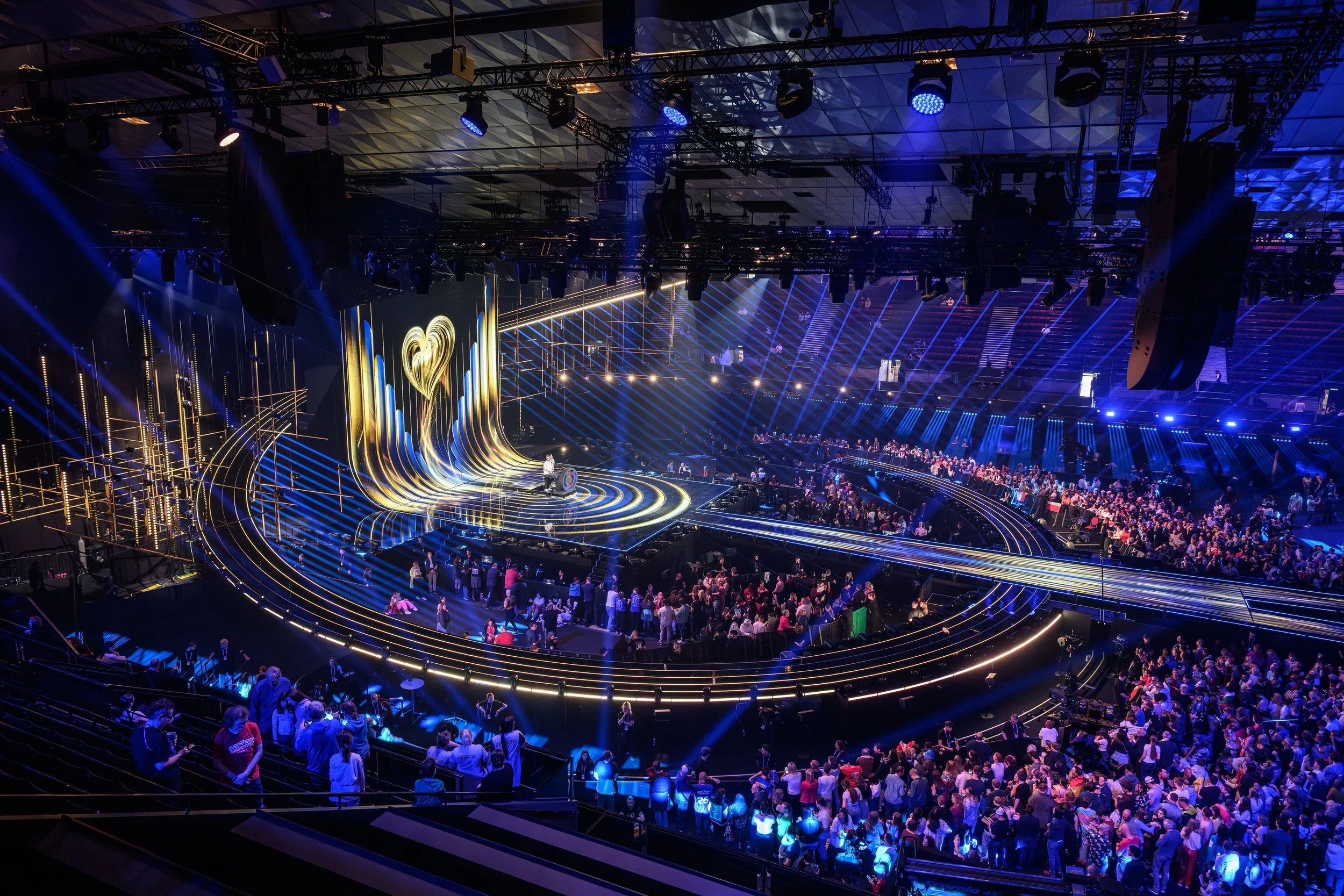
This year's set was really two performance areas in one: a main stage at one end of the arena, a green room at the other where the artists sat and waited, and a long catwalk joining them. As the directors used the whole space, hosts and performers ended up active at both ends at once, one host speaking from the main stage while another answered from the green room. This is something that conventional PA processing cannot adequately address. Although implementing dedicated main and reverse PA systems for each stage is relatively simple, the alignment of the shared delay lines and fill loudspeakers remains a significant challenge.
Since conventional processors can only maintain one delay alignment direction at a time, the system must switch between fixed snapshots, making seamless operation between stages impossible.
This year, the goal was to have both stages operating simultaneously, ensuring that every listener in the hall perceived each voice as originating from the correct end of the room, while preserving continuous, dynamic time alignment for any source position between the two stages.
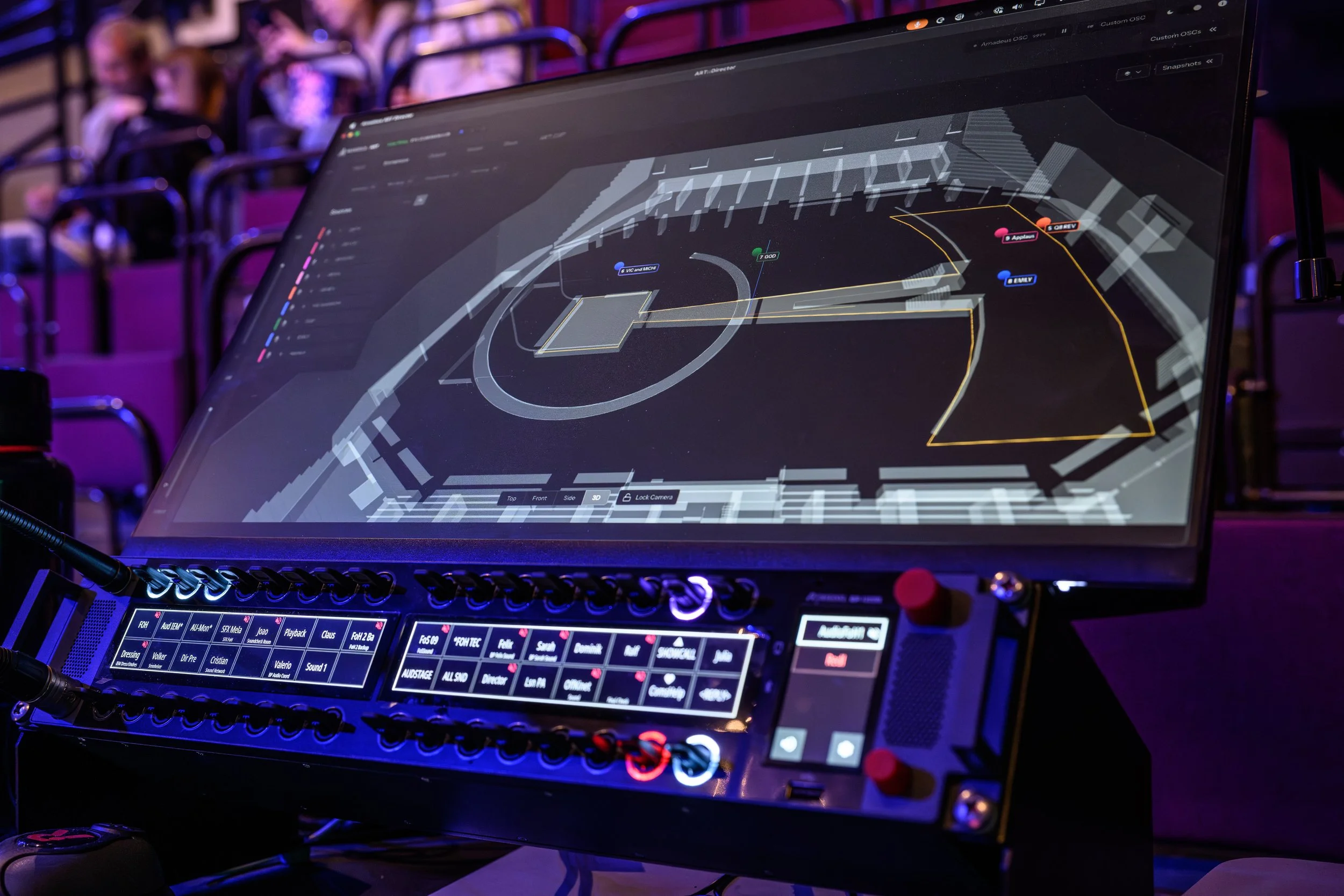
ART::Director, control software for ART::IP, at ESC 2026. Photo: Hans Leitner
How ART::IP Solved It
This is where ART::IP became essential, and its role was vital rather than decorative. Amadeus Acoustics built a full 3D model of the arena in ART::Director and divided the audience into zones. For each source, the system's performer processing continuously calculated the delay and gain to every zone, optimised down to one by one metre blocks, so that a listener anywhere in the hall placed each host at their true position on stage, even with both speaking at once. As focus shifted from one end to the other, a fading zone handed the sound from one PA across to the opposing one automatically. The team worked with a small number of fixed source positions, mainly the hosts, rather than moving objects, so the audience microphones and the broadcast mix stayed perfectly aligned.
One moment stood out in particular: at the opening of the grand finale, the orchestra played from the green room. Using ART::IP, the sound was convincingly placed at the far end of the arena, prompting the entire audience to turn their heads toward the perceived location of the orchestra purely through the spatial audio cue. All of it ran on two ART::Box processors in a fully redundant layout with automatic failover across a dual Dante network, which proved itself when the main path dropped during a rehearsal and the system moved to its backup with no one noticing.
On the night, ART::IP sat at the centre of the front of house workflow. Richard Redl mixed the show elements: the hosts, the interviews, the voting and every cue in between, while Johannes Minichmayr mixed all of the music on time code, close to 650 cues across the broadcast. Both placed their full trust in our newly released ART::IP, for its engineering, its reliability and the support of the Amadeus Acoustics team behind it.
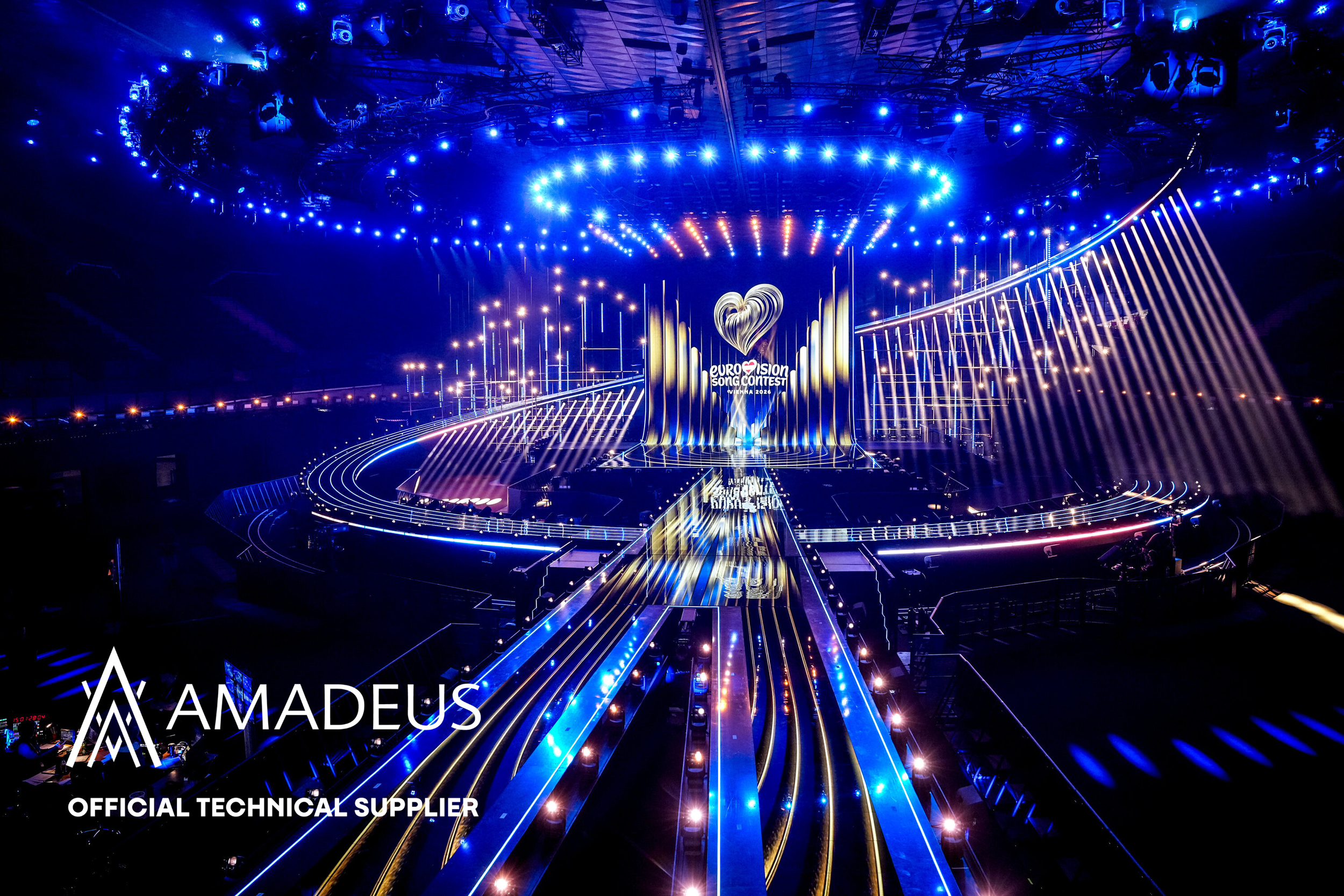
Eurovision 2026 - Wiener Stadthalle
System at a glance
ART::Box (2x): Box shaped, CPU based signal processor for Amadeus ART::Freedom applications. 512 / 512 Dante I/O, 48 to 96 kHz
ART:: IP 256 (2x): Immersive Performance module for Amadeus ART::Performance applications. 128 objects, 256 outputs of live immersive audio processing.
36 × L-Acoustics X8 (floor and front fills)
20 × L-Acoustics L2 (main, side, corner, FOH and stand positions)
2 × L-Acoustics K2 (front clusters)
2 × L-Acoustics KARA II (sidefills)
Highlights:
Front and reverse PA, live at once. For the first time at Eurovision, both PA directions ran simultaneously rather than as switched snapshots.
Source accurate localisation. Per zone delay and gain, optimised to one by one metre blocks, anchored each host to their real position for every seat in the hall.
Automatic handover. A fading zone moved sound from one PA to the opposing system as focus crossed the room, with no manual switching.
A live orchestra from the green room. For the grand final opening, ART::IP placed the orchestra at the far end of the arena, creating a powerful spatial cue that made the audience turn toward its perceived location.
Fully redundant. Two ART::Box processors with automatic Dante failover, proven live when one system was powered down mid rehearsal, unnoticed.
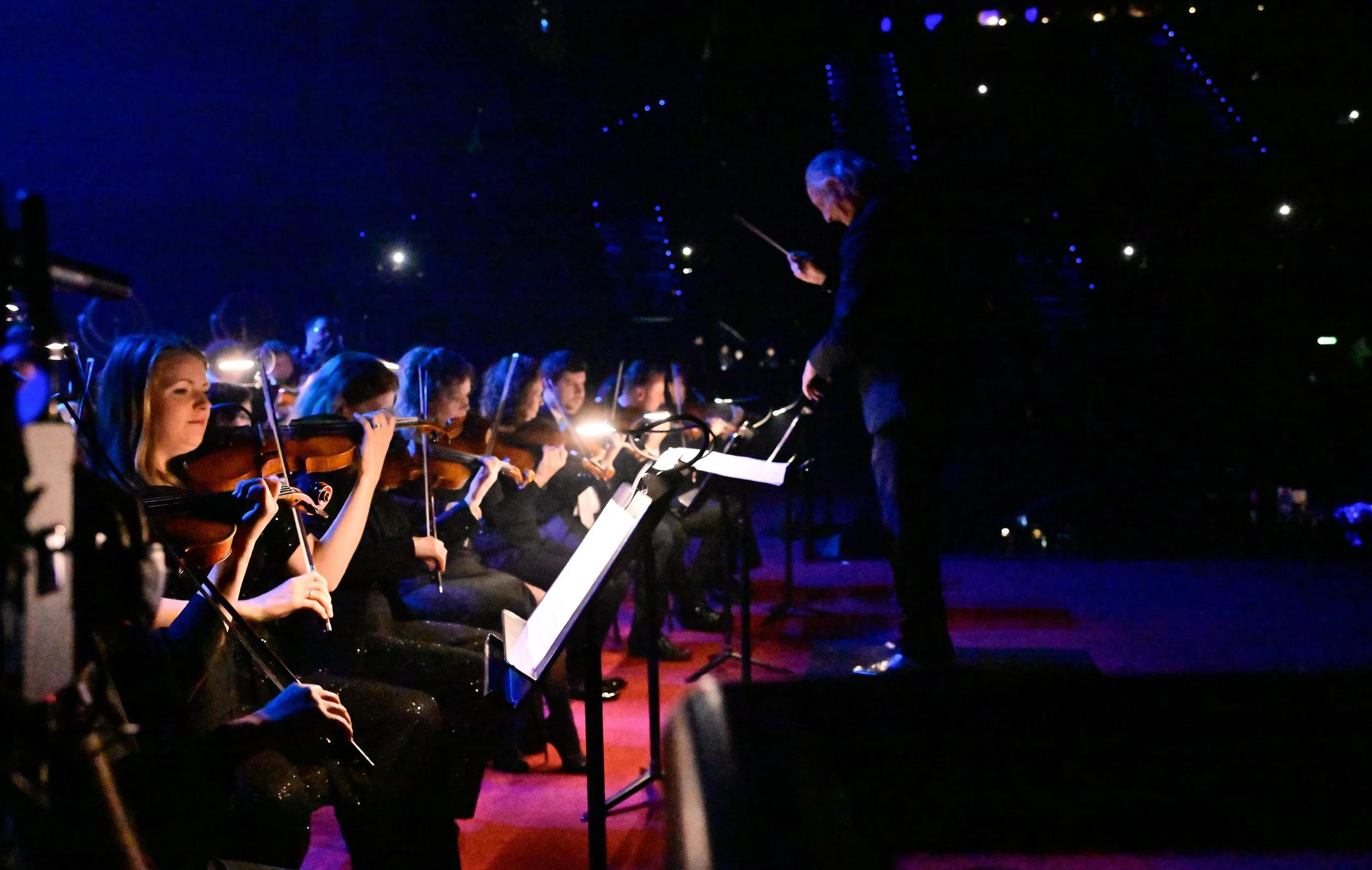
Orchestra at the opening of the ESC 2026 Grand Finale
Trust on the Biggest Stage
Bringing a newly released system onto a stage this size is not a small decision, and no one pretended otherwise. Eurovision's expert sound team were understandably careful at first. Over two to three days of trials, with Amadeus Acoustics on site, that caution turned into confidence. The verdict was plain: if the system had not met their expectations, they would not have used it. And they would happily work with Amadeus Acoustics again.For a production built to play it safe, in front of one of the largest live audiences in the world, that judgement from the people who carry the show says more about ART::IP than any specification could.
Shaping the Future of Live Sound
Eurovision 2026 put ART::IP to work at arena scale, in front of thousands of live spectators and a broadcast audience. It is a clear demonstration of what object based spatial audio can deliver in one of the world's largest live music events.
Want to hear what ART::IP can do for your own venue or production? Get in touch with Amadeus Acoustics to arrange a demo, or explore the system in full on our ART::IP page here.
Related projects